Ecosystem signals aren't data. They're intelligence.
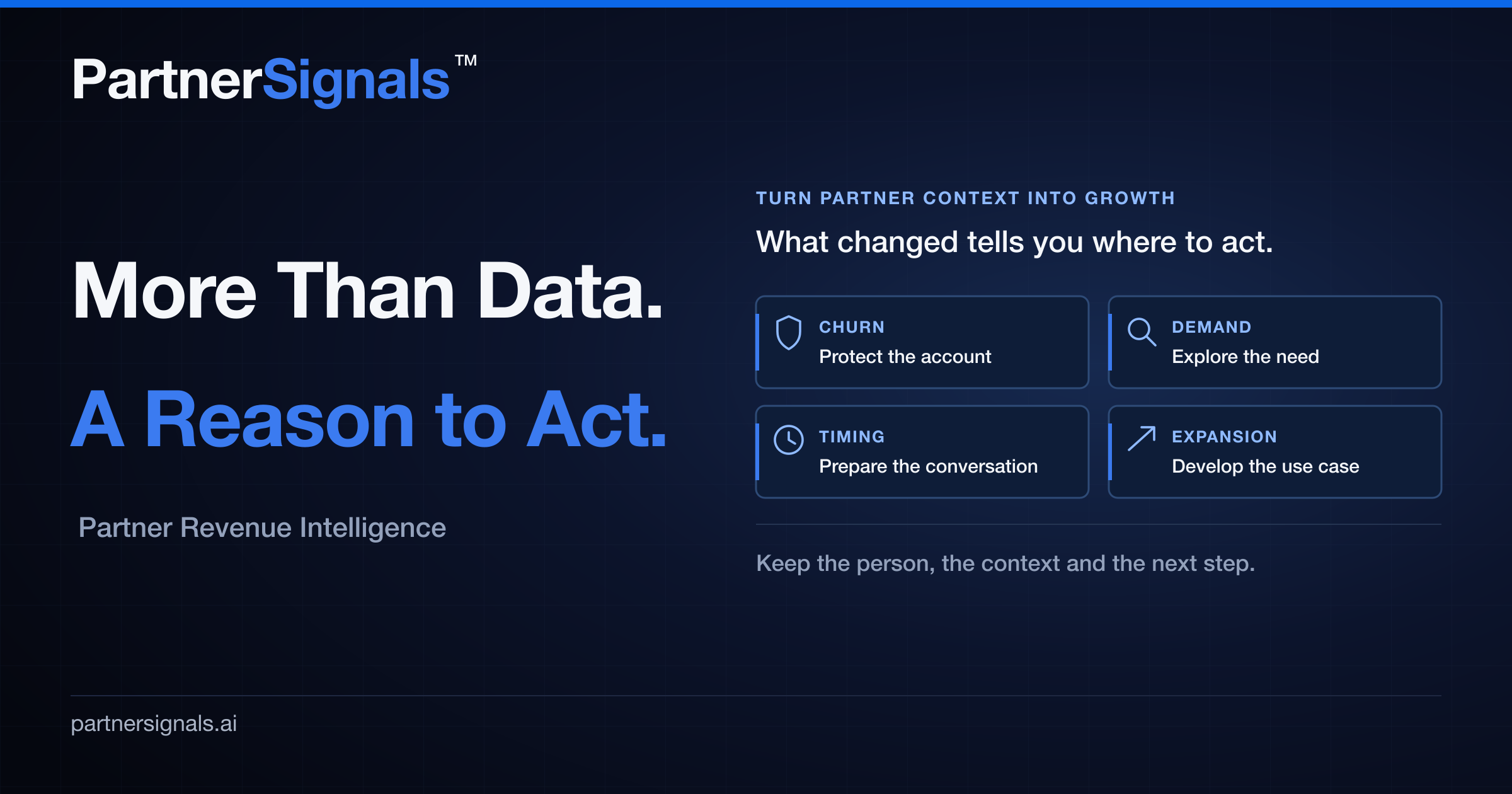
What a partner knows about a customer can show you where to protect revenue, find demand and grow the account.
“We both work with that customer” is a useful start.
“Their architecture team is reviewing a replacement platform, and the consultant leading the review wants your input” gives you something to do.
An overlapping account is a starting point; what partners know and do is the signal.
The difference is context. Who is involved? What changed? Why does it matter now? A name on a shared account list helps you find the relationship. A conversation with the person doing the work helps you understand the opportunity.
That is where ecosystem data becomes intelligence you can act on.
Listen for what changed
Partners spend time in customer conversations your team may never attend. They help plan architectures, implement systems, review business priorities and solve problems after a deployment.
Those conversations can reveal a new need before the customer opens a formal evaluation. They can also show a change inside an existing account while your team is still working from the previous plan.
Signals can appear before pipeline. They still need interpretation. A customer exploring an idea has not necessarily agreed to buy anything, and a partner's observation is not a commitment from the buyer.
The useful habit is to recognize the kind of change you are hearing, then ask a question that tests what it means. These examples illustrate four places to start.
Churn: a reason to revisit the customer's experience
A systems integrator mentions in an account planning session that a customer is evaluating another platform.
That is a churn signal. It gives the account team a reason to understand what the customer wants to change. There may be an unresolved implementation problem, a new requirement or a different view of what success should look like.
Ask the consultant what prompted the evaluation, who is involved and whether the customer would welcome a conversation. Bring in the customer success lead with the history of the account.
The opportunity is to address a real concern while the customer is still considering their options. Treat the observation as a reason to investigate, and record what the customer confirms.
Demand: a problem looking for an approach
A hyperscaler partner asks for a joint architecture session at an account that is not yet in your pipeline.
That request can be a demand signal. Someone is working through a problem that may fit what you offer. The partner may know who owns it and why they are asking now.
Before putting a revenue number against it, find out what the session is meant to resolve. Is the customer exploring possibilities, choosing an approach or preparing a funded project? Which person needs to be part of the discussion?
Prepare around that question. A useful technical conversation earns the right to explore whether there is business to pursue.
Timing: a reason to prepare now
A solution provider's quarterly business review reveals that a customer plans to consolidate vendors.
That is a timing signal. It may create an opening for a broader conversation about the problems your product can solve. It may also mean the customer has a decision process your team needs to understand before proposing anything.
Ask who is leading the review, what drives the timetable and which commitments are already fixed. A contract deadline, a planning meeting and a tentative ambition carry different implications.
With the partner, work out when your contribution would be useful. The right conversation too late in the process may have little room to change the decision.
Expansion: a new use case taking shape
An implementation team notices that a customer's usage patterns changed after a partner integration.
That can be an expansion signal. A workflow may now serve another department. A team may be using the product to solve a problem beyond the original deployment.
Ask the implementation lead what changed and who is using the new workflow. Check with the customer whether it is delivering value, creating friction or simply passing through a temporary spike.
If there is a lasting need, involve the account owner and the person responsible for that work. The growth opportunity comes from understanding what would help them next, not from treating every increase in activity as a buying decision.
Keep the context attached to the signal
“Customer interested” is too thin to work with. Record the person who observed the change, when it happened, what they heard directly and what still needs confirmation.
Bring that context into the CRM with the account, contact and agreed next step. Your team can then use it alongside the customer conversations already recorded there.
Time matters. An architecture review can finish. A consolidation plan can move. The person who wanted help can change roles. Check that the observation still holds before acting on it.
At your next partner conversation, ask what has changed for a customer you both know. Listen for the need, the timing and the people involved. Then agree on a useful response.
That is how a shared account becomes an informed growth decision.
Get new posts by email: Subscribe on Substack →