Oracle Is Investing $1B in Partners. Are You Investing in Your Ecosystem to Drive Growth?
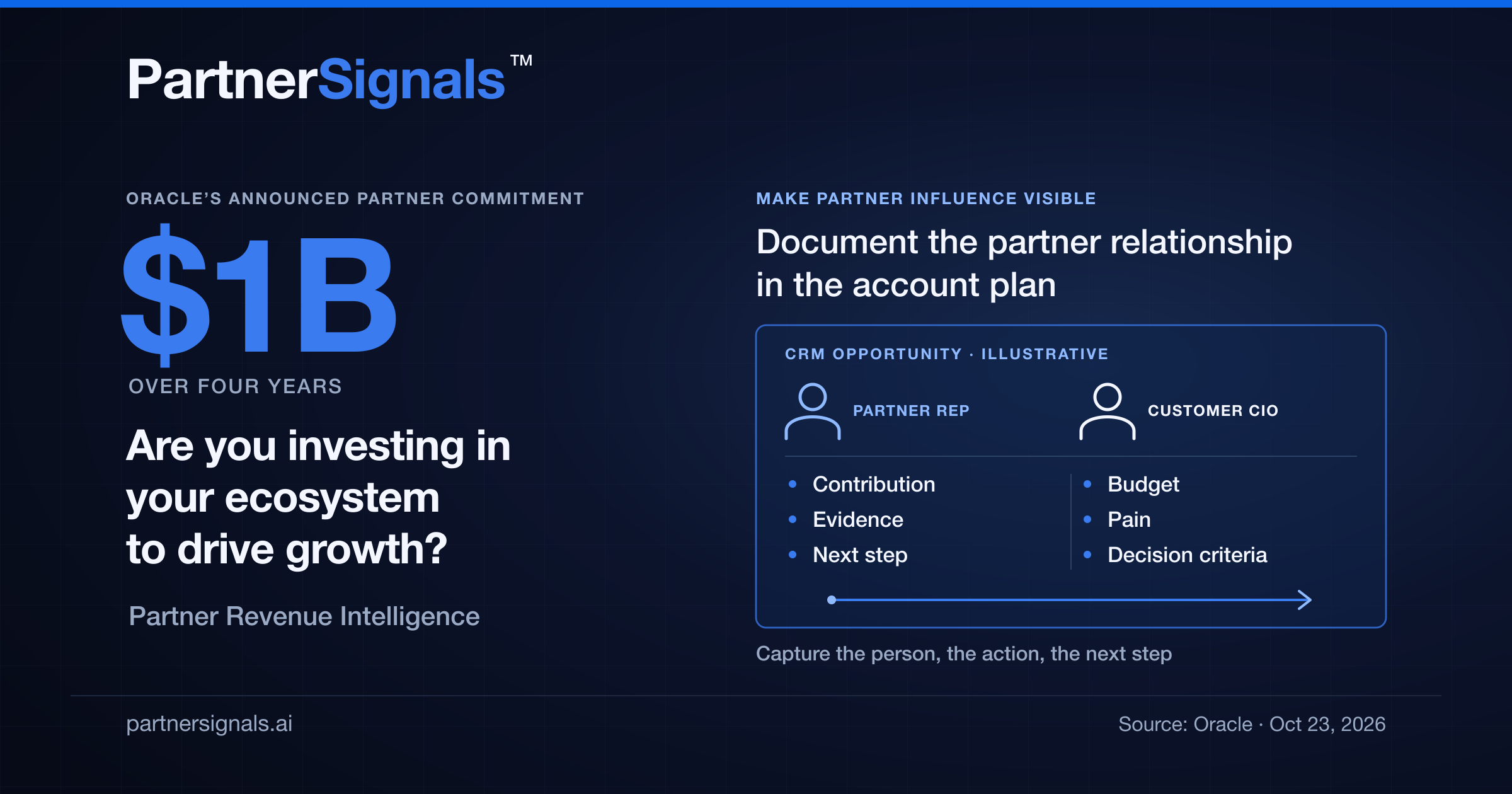
Oracle has put a number behind its bet on partners: $1B over four years.
The October 23, 2026 Oracle announcement covers training, technical enablement, development and testing environments, cloud migration funding, go-to-market collaboration, and Oracle Marketplace.
The same day, Oracle Marketplace introduced Private Offers Co-Sell. It connects eligible software vendors with Oracle sellers on qualified opportunities.
Oracle is investing in partners to grow. Every company wants both: new customers, and more sales to the ones it already has. Your budget may be smaller. The question still applies: are you investing in your ecosystem to drive growth?
Investment is not only money
Review the active opportunities in your pipeline. Which partner reps already have access to the customer's CIO? Where could that relationship support an introduction or help your team understand the customer's priorities?
On October 26, Numeral launched its partner program. Its head of accounting strategy and partnerships called partners “the trusted voice their clients turn to when compliance gets complicated.”
In my experience, a partner rep is often already in the room. They hold a QBR with the customer's CIO because the customer spends heavily with their company. They are among the vendors the CIO makes time for. I cannot cite a study for that, so check it in your own accounts. A seller whose product sits twentieth on that list usually does not get that meeting. The partner rep does.
Invest in that relationship. Make sure the partner rep understands the customer priorities your team can address. Agree on the purpose of an introduction and the follow-up it requires.
Include the partner rep's relationship and agreed role in the account plan. The account team needs to know whom to involve, why the relationship matters, and what happens next.
That is an investment you can make before the next budget meeting.
Partner investment needs evidence
Bain reviewed AI pricing across about 200 B2B SaaS companies in its August 10 analysis and found that only about 10% of AI pricing meters charge for a business result. For a result to be billable, Bain says it has to be observable, uniquely attributable, and contractible. It also notes that marketing attribution is often disputed. TechTarget reports the same problem when several technologies and workflows contribute to a result.
Neither source is about partner programs. They show how hard it is to credit one contributor when several are involved, and partner contribution has the same problem. A partner's name on the opportunity is only the starting point. Ask what the partner rep actually did.
Three things to capture this quarter
Start with the active opportunities that involve a partner. The account owner fills in three things at the next pipeline review. A few fields on the opportunity are enough to begin.
- The relationships. The partner organization, the partner rep, and the customer CIO they know. If the connection is unknown, leave the gap visible and ask the partner rep.
- The contribution. What the partner rep actually did: an introduction, a customer requirement clarified, a concern addressed. Link the meeting note.
- The next step, with an owner and a date. A promised introduction is still a next step.
A first-touch date shows sequence, not influence. A partner rep who joins later can still be the one who resolves the customer's concern. Record what they did, not only when they appeared.
At the QBR, compare closed-won and closed-lost opportunities. In the pipeline review, check the ones that have stalled. Look for where earlier partner involvement could have helped. A blank field is a reason to ask, not proof that no partner helped.
Growth you can see
The CRM stays the system of record. Partner signals converge into it: introductions, conversations, and buying context. The account team can use that context to plan the next customer conversation.
That is the gap Partner Revenue Intelligence addresses: making partner influence visible so you can grow partner-influenced revenue you can forecast.
Before your next pipeline review, ask each partner-touched account owner to name the partner rep and the customer CIO they know. Count how many cannot.
Is the partner relationship visible in your CRM before the opportunity stalls?
Sources
- Oracle, partner ecosystem commitment, October 23, 2026: https://www.oracle.com/news/announcement/ai-world-oracle-announces-1-billion-commitment-to-partner-ecosystem-2026-10-23/
- Oracle Marketplace, Private Offers Co-Sell, October 23, 2026: https://www.oracle.com/middleeast/news/announcement/ai-world-oracle-expands-marketplace-to-unlock-new-partner-growth-opportunities-2026-10-23/
- Numeral, Partner Program launch, October 26, 2026: https://www.numeral.com/blog/numeral-launches-new-partnership-program
- Bain, “AI Pricing: A Reality Check on Effort, Usage, and Outcomes,” August 10, 2026: https://www.bain.com/insights/ai-pricing-a-reality-check-on-effort-usage-and-outcomes/
- TechTarget, “Outcome-based AI pricing hits a measurement problem,” August 26, 2026: https://www.techtarget.com/enterprise-software/feature/Outcome-based-AI-pricing-hits-a-measurement-problem
Get new posts by email: Subscribe on Substack →